PPE Basics Toolbox Talk: Your Last Line of Defense


Personal protective equipment is the most visible part of safety — the hard hats, glasses, gloves and boots that mark a working crew. But here’s the thing most toolbox talks get backwards: PPE is not the first line of defense. It’s the last one.
Safety professionals rank protections using the hierarchy of controls, from most effective to least: eliminate the hazard, substitute something safer, engineer it away with guards and ventilation, control it with procedures and training — and only then, put gear on the person. When PPE is all that’s left, it has to be the right equipment, in good condition, worn correctly, every single time.
PPE is the only control that fails the moment you decide not to use it.
Why is PPE safety important?
The numbers make the case better than any lecture. NIOSH reports that about 2,000 U.S. workers sustain a job-related eye injury requiring medical treatment every single day — and safety experts believe the right eye protection could prevent or soften the vast majority of them. That’s one hazard, one body part, one piece of gear. Multiply across hands, feet, heads, lungs and ears and the picture is clear: most PPE-preventable injuries happen to workers who had the gear and weren’t wearing it, or wore the wrong type.
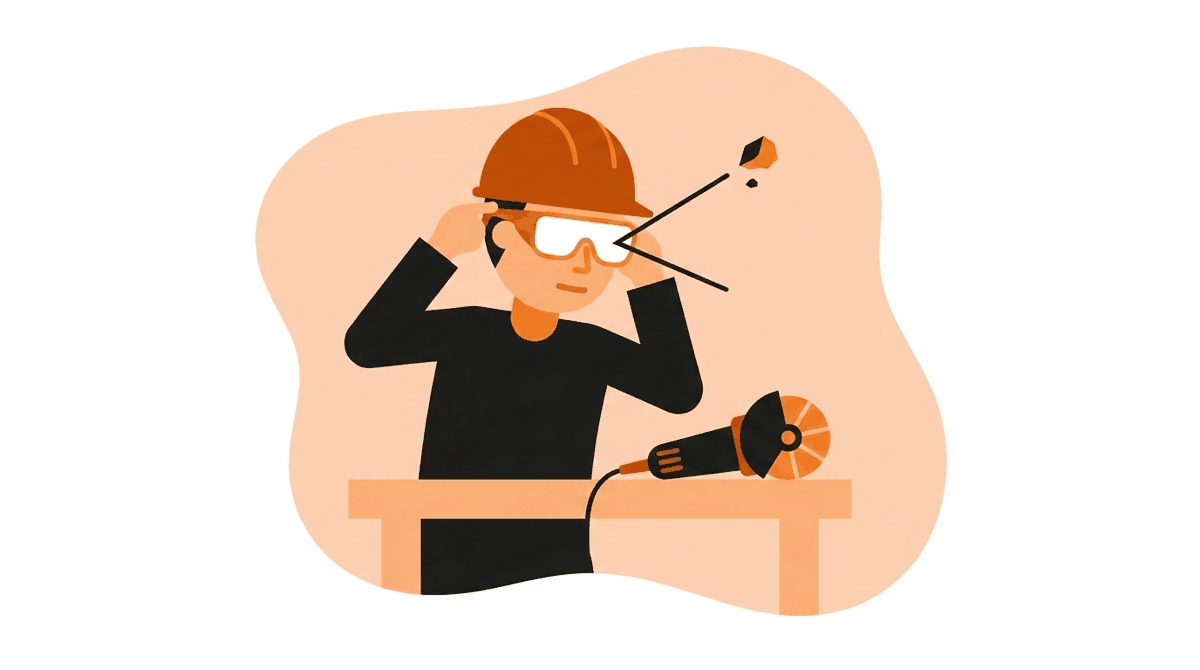
PPE matters precisely because it’s the last barrier. When a grinder disc shatters or a chemical splashes, there’s no time left for planning — either the barrier is already on your face, or it isn’t. But remember the hierarchy: the best jobsites work on eliminating hazards first, so the PPE rarely gets tested.
OSHA regulations for PPE
The core general industry standard is 29 CFR 1910.132 — General requirements for PPE. In plain English:
- Hazard assessment. Your employer must assess the workplace to determine which hazards are present and which PPE is required — certified in writing (1910.132(d)).
- Right gear, good condition. PPE must be appropriate for the hazard, fit properly, and be maintained in reliable condition.
- Training. Workers must be trained on when PPE is necessary, what kind, how to wear and adjust it, its limitations, and its care (1910.132(f)).
- Employer pays. With few exceptions (like ordinary steel-toe boots you can wear off site), the employer must provide required PPE at no cost to workers (1910.132(h)).
Specific standards then cover each type: 1910.133 for eye and face, 1910.135 for head, 1910.136 for foot, 1910.138 for hand protection, and 1910.134 for respirators. Construction has parallel rules in 1926 Subpart E.
PPE hazards
PPE failures usually look like one of these:
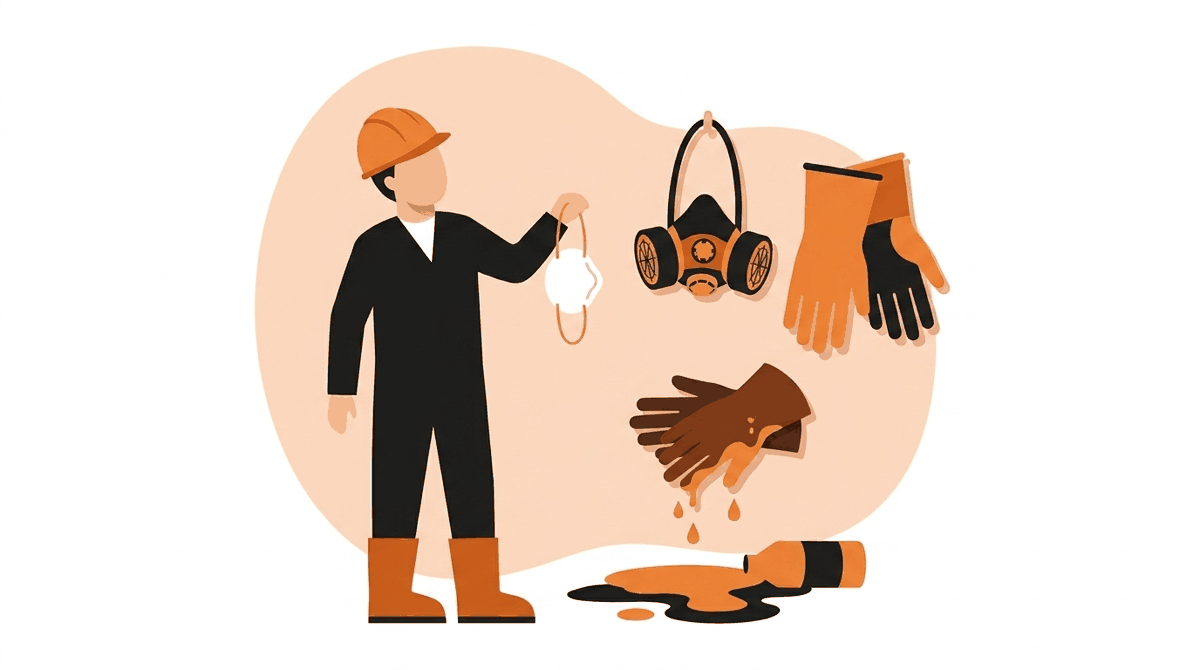
- A worker wears his prescription glasses instead of rated safety glasses while cutting concrete. A chip ricochets around the lens from the side.
- Leather gloves on a chemical transfer job. The solvent soaks straight through and the “protection” holds the chemical against the skin.
- A dust mask on a job that needs a fitted respirator. It feels protective. It isn’t.
- Hearing protection that lives around the neck instead of in the ears, because “it’s just a quick cut.”
- Gloves worn at a rotating drill press or bench grinder — the one place gloves make things worse by pulling your hand into the machine.
Notice the pattern: it’s rarely “no PPE at all.” It’s the wrong PPE, worn wrong, or set aside for sixty seconds.
PPE basics toolbox talk
Let’s get practical about the gear you put on every morning.
First question for every task: is PPE even the right answer? If we can eliminate the hazard — cut on the bench instead of overhead, wet-cut instead of dry, guard the machine, ventilate the space — that beats any gear. Speak up when you see a hazard we could remove instead of just dressing for.
Second: right gear for the actual hazard. Safety glasses are not face shields — grinding and chipping need both. Leather gloves are not chemical gloves. A dust mask is not a respirator. If you’re not sure what the task calls for, ask before you start, not after the exposure.
Third: fit and condition. Take ten seconds to inspect before use — scratched lenses, split gloves, cracked hard hats, ear plugs gone stiff. Damaged PPE is worse than none, because it lets you take risks you’d otherwise avoid. If your gear is worn out, get it replaced. It costs you nothing — that’s the law.
Fourth, and this is the big one: 100 percent of the time. Most PPE injuries happen in that little window where the glasses come off to wipe sweat, the gloves come off for dexterity, the plugs come out to hear someone. If you need to remove PPE, step out of the hazard zone first.
Your gear only works when it’s on. Nobody plans the moment the disc explodes — you just get to find out what you were wearing when it did.
Questions to employees
Ask your crew — a quick check that the talk landed:
- What are the five levels of the hierarchy of controls, from best to last?
- Why is PPE considered the last line of defense rather than the first?
- What PPE does your current task require, and how do you know?
- When did you last inspect your hard hat, glasses and gloves for damage?
- Who pays for required PPE — and what do you do when yours is worn out?
- Can you think of a task on this site where we could eliminate a hazard instead of relying on PPE?
Promote PPE safety with this email template
Hi [Name],
A quick reminder about personal protective equipment this week:
- Wear the PPE specified for your task 100% of the time you’re in the hazard area — not most of the time.
- Check your gear before use. Scratched lenses, split gloves and cracked hard hats get replaced, not tolerated. Replacement PPE is always available at no cost to you.
- Match the gear to the hazard. If you’re unsure whether a task needs a face shield, chemical gloves or a respirator, ask your supervisor first.
Remember, PPE is our last line of defense — if you see a hazard we could eliminate or guard instead, I want to hear about it.
Thanks for looking out for each other,
[Your Name]
Conclusion
PPE is the humblest control we have: it doesn’t remove a single hazard, it just stands between the hazard and you. That makes the rules simple — right gear for the real hazard, inspected, fitted, and worn every minute you’re exposed. Push for elimination and engineering controls first, then treat the gear you’re left with like your life depends on it. Some day it will.


